
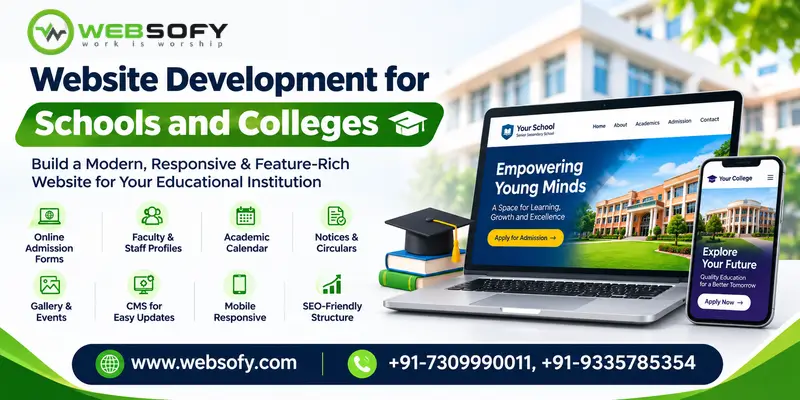
A school's or college's website is often the first place parents, students, and prospective applicants visit when they want to learn about an institution. They look for admission details, courses, facilities, faculty information, results, and contact details before making a decision. A website that presents this information clearly can make communication easier and create a professional impression.
Website development for schools and colleges requires more than an attractive homepage. Educational institutions need well-organized information, convenient inquiry options, and features that support their daily communication. Websofy develops website solutions around these requirements, helping schools and colleges present their identity, share important updates, and connect with their audiences through a responsive digital platform.
Professional Website Development Services for Educational Institutions
Every educational institution has its own identity, audience, and administrative requirements. A school may need class-wise information and parent communication, while a college may require detailed program pages, department information, and admission facilities. A generic website template may not address these differences effectively.
Websofy provides educational website development services planned around the institution's objectives. We consider the content, design, navigation, and functionality needed to make the website useful for students, parents, faculty members, and administrators. Whether you manage a private school, degree college, university, or training institute, the website should reflect your institution accurately and make essential information easy to access.
School Website Development: Features Every Modern School Needs
A school website should help parents understand the institution and find answers to common questions without depending entirely on office calls. Important information such as classes, curriculum, facilities, admission procedures, school timings, and contact details should be organized into clear sections.
Our school website development approach considers the needs of CBSE, ICSE, and state-board schools, along with other educational institutions. Depending on the project, the website can include admission inquiry forms, faculty profiles, academic calendars, event updates, galleries, and downloadable documents. A well-planned school website also gives authorized staff a convenient way to update notices and institutional information, keeping parents and visitors informed throughout the academic year.
College Website Development for Higher Education Institutions
A college website serves several audiences, including prospective students, enrolled learners, parents, faculty members, alumni, and academic partners. Visitors may want to compare programs, check eligibility, explore departments, understand campus facilities, or review placement information. The website should make these details easy to locate.
Websofy offers college website development services designed around these information needs. A college website can include course and department pages, faculty profiles, admission information, prospectus downloads, research updates, placement details, and student resources. The structure should also accommodate institutional documents and public disclosures where applicable. A clear, organized website helps a college communicate its academic strengths and provide reliable information to people considering admission.
Online Admission Forms and Enquiry Management
Admission is one of the most important activities for schools and colleges. When applicants cannot find clear instructions or an easy way to inquire, institutions may lose genuine inquiries. An online admission facility can make the initial process more convenient by allowing visitors to submit their details through the website.
A suitable school admission website development solution may include class selection, parent details, inquiry forms, and admission instructions. For colleges, an online admission portal may collect programme preferences, applicant information, and supporting details according to the institution's process. Form fields, data access, notifications, and storage should be planned carefully. The website should explain what happens after submission rather than suggesting that an inquiry automatically confirms admission.
School and College Website Design That Reflects Your Institution
The design of an educational website should communicate the institution's identity while keeping information accessible. Parents and students should not have to search through complicated menus to find admission details, academic information, or contact options. A clear layout makes the experience more comfortable and encourages visitors to explore relevant pages.
As a school website design company, Websofy focuses on visual consistency, readable typography, useful navigation, and layouts suited to the institution's audience. The design may include the institution's logo, brand colors, campus photographs, facilities, and academic highlights. College websites may need additional navigation for departments, programs, research, and accreditation information. The final design should look professional without allowing decorative elements to distract from essential information.
Essential Features of a School and College Website
The right features depend on how an institution communicates and manages information. A small school may need a simple content management system and admission enquiry form, whereas a larger college may require several departments, document sections, and integrations. Planning the feature list before development helps control complexity and project costs.
School website features | College website features |
Class and curriculum details | Courses and programme information |
Admission enquiry forms | Online application forms |
Faculty and staff profiles | Department and faculty profiles |
Notices and academic calendar | Examination and academic notices |
Facilities and photo gallery | Research and placement information |
Parent and student resources | Student resources and portals |
Mandatory public disclosures, where applicable | Institutional disclosures, where applicable |
The website should include only features the institution can maintain and use effectively.
Responsive Website Development for Mobile Users
Parents and students often access educational websites through smartphones. They may check admission dates while travelling, read a notice from home, or look up a college course using a mobile search. If the website is difficult to use on a smaller screen, important information can become frustrating to access.
Websofy plans responsive website development so that page layouts adapt to mobile phones, tablets, laptops, and desktop screens. Navigation, text, images, buttons, and forms should remain usable across common screen sizes. Mobile testing is important because a layout that looks good on a desktop may not work equally well on a phone. A consistent experience helps visitors find information and complete inquiries more comfortably.
SEO-Friendly Website Development for Schools and Colleges
A website should be built so that visitors and search engines can understand its pages. Clear URLs, descriptive page titles, useful headings, internal links, and relevant content help establish the purpose of each section. Technical problems such as broken links, slow-loading pages, or inaccessible content can also affect the visitor experience.
Our SEO-friendly website development approach considers these elements during planning and implementation. Each important course, department, service, or admission page should have a clear purpose and useful information. Image optimization, mobile usability, XML sitemaps, HTTPS, and appropriate structured data may also form part of the technical setup. Development supports search visibility, but rankings also depend on content quality, competition, relevance, and ongoing SEO work.
CBSE Mandatory Public Disclosure and Institutional Information
Educational websites may need to publish information required by their respective boards or regulatory bodies. For CBSE-affiliated schools, the Mandatory Public Disclosure section is particularly important. CBSE Circular No. 09/2021 directs affiliated schools to display a prominent link to this information on their website homepage, following the prescribed disclosure format.
A website should therefore provide an accessible section where the school can publish applicable documents and update them when required. Colleges may have different disclosure requirements depending on their recognition, affiliation, and regulatory framework. Websofy can plan suitable document sections and navigation as part of the website project. The institution remains responsible for confirming the accuracy and completeness of its official disclosures.
CMS, ERP, and LMS Integration for Educational Institutions
An educational website should be manageable after launch. If every small change requires a developer, staff may struggle to keep notices, events, course details, and admission information current. A Content Management System (CMS) allows authorized users to update supported website content through an administrative dashboard.
Larger institutions may also need connections with other systems. An ERP integration can connect selected website functions with institutional administration software, while a Learning Management System (LMS) supports online learning and course delivery. Student Information Systems, payment gateways, or enquiry management tools may also be relevant. Integration requirements should be reviewed individually because not every platform supports every connection. The scope, data flow, permissions, and security arrangements should be agreed before development.
Website Development Cost for Schools and Colleges
The cost of developing an educational website depends on its size, design, content, and functionality. A basic school website with essential information pages will generally require less work than a college portal with multiple departments, online applications, dashboards, and third-party integrations. The number of pages alone does not determine the final price.
Before requesting a quotation, consider these factors:
Number of pages and departments.
Custom design and branding requirements.
Admission forms and application workflows.
CMS and administrator access.
ERP, LMS, or payment gateway integrations.
Content writing, photography, and document uploads.
Domain, hosting, security, and maintenance.
Websofy can discuss the requirements and prepare a project-specific proposal. A clear quotation should explain included features, deliverables, estimated timelines, support arrangements, and recurring charges, if any.
Our Website Development Process for Schools and Colleges
A structured development process helps an institution understand what will be delivered and when its team needs to provide information or approvals. It also reduces the risk of adding features late in the project without reviewing their impact on cost and timelines.
Websofy follows a requirement-led approach. The process begins with understanding the institution's goals, audience, and existing digital setup. Next, the sitemap and feature list are planned, followed by design and development. The website is then reviewed for content accuracy, mobile usability, forms, links, and agreed integrations. After approval, it can be published on the selected hosting environment. The institution should receive the agreed access details and guidance for managing its website.
Why Choose Websofy for School and College Website Development?
Selecting a development company involves more than comparing design samples or prices. An institution needs a team that understands its communication requirements, plans the right features, and explains the work clearly. The website should also be manageable by authorized staff after launch.
Websofy approaches website development for educational institutions with attention to structure, usability, responsive design, and project requirements. We can discuss the difference between a school website, a college website, and a portal with additional functionality before recommending a development approach. Project scope, integrations, content responsibilities, delivery expectations, and support should be agreed in advance. Institutions can also request relevant examples or demonstrations, where available, to evaluate whether the proposed solution fits their needs.
Website Development Services for Schools and Colleges in Lucknow
Schools and colleges in Lucknow need websites that serve their local audiences while remaining accessible to visitors from other cities. Parents may search for school facilities and admission details, while students may compare college programs, eligibility, and campus information before applying. A useful website should answer these questions clearly.
Websofy provides website development solutions for educational institutions looking for a professional online presence. Whether your institution is based in Lucknow or serves students across Uttar Pradesh, the project can be planned around its audience, content, and required features. If you are comparing a school website development company in Lucknow or a college website development company in Lucknow, discuss your requirements, expected functionality, and support needs before choosing a development partner.
Build a Professional School or College Website with Websofy
Your institution's website should make it easier for parents, students, and applicants to understand what you offer and find the information they need. It should also give authorized staff a practical way to maintain important updates throughout the academic year.
If you are planning a new website or replacing an outdated one, Websofy can help you review the requirements and select an appropriate development approach. Discuss your institution's pages, admission process, integrations, and future plans with our team before finalizing the project.
Websofy – Website Development for Schools and Colleges
Call: +91-7309990011 | +91-9335785354
Website: www.websofy.com