
Project overview
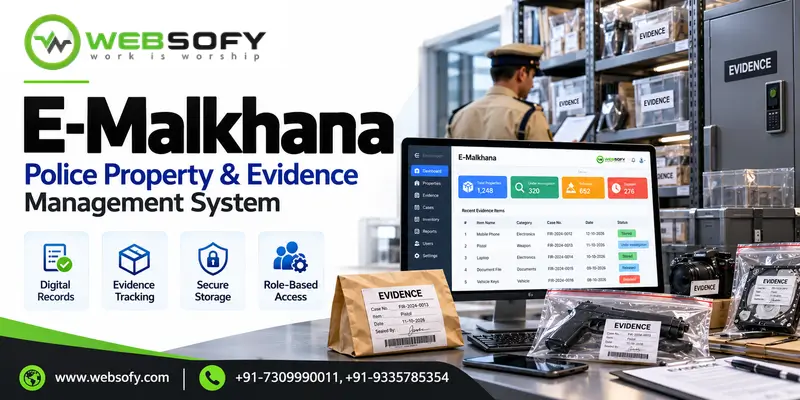
E-Malkhana is web-based police software that records every seized item from seizure to disposal with one Malkhana Receipt (MR) number, one barcode or QR sticker and a full chain of custody. Websofy Software Pvt. Ltd., Lucknow, built it for police malkhanas in Uttar Pradesh, where it runs as a module of the Lucknow Police portal.
| At a glance | Details |
| Built for | Police Commissionerate, Lucknow, Uttar Pradesh |
| Built by | Websofy Software Pvt. Ltd., Lucknow |
| Users | 10 roles, from Investigating Officer to Commissioner |
| Screens | 29 screens under Malkhana Operations, 10 reports in the Report Center |
| Languages | Hindi and English, with a switch on every page |
| Access | Computer and mobile browser, each user limited to their own jurisdiction |
What is E-Malkhana?
E-Malkhana is the malkhana register kept on the computer. It records the case, the seizure memo, each seized item, its storage, every issue and return, and the final disposal on court order. Each item gets an MR number and a printable sticker when it is deposited.
What problems does it solve?
A paper malkhana register makes it hard to say where an item is, who last held it and whether a court order has been followed. E-Malkhana gives every item a single record. It shows its location, its movements and the officer responsible. It also flags disposals that run past 15 days.
How does property move through the system?
| Step | What happens |
| Case | The FIR is entered once with acts, sections, IO, court and persons involved. |
| Seizure memo | The fard is recorded with date, place and a scanned copy. |
| Seized item | Type, storage and photograph are entered, and the MR number and sticker are created. |
| Deposit | Cash goes to the bank and jewellery to the locker. |
| Issue and return | Items go to the IO, a court or the forensic lab and come back with a record. |
| Disposal order | Items are named in the court’s order. |
| Handover | Release, supurdagi, auction or destruction is recorded item by item. |
| Closed | The case is closed with the court order. |
How does E-Malkhana maintain the chain of custody?
Every issue and return is recorded with date and officer. An item sent to the IO carries an expected return date. An item sent to a court or lab carries the order number and the receiver’s name, and the FSL report number, date and result are entered on return. An item that is out cannot be issued, deposited or disposed of again until its return is recorded.
How is disposal on court order recorded?
The court order number, date and scanned order are attached to the disposal. Only a person linked to the same case can receive the property. Part of a quantity or amount can be released, and the handover log records who collected the item, when and with what ID proof.
What rules does the system enforce?
- No item without a memo: property cannot be entered until the case has its seizure memo.
- Storage rules: cash, jewellery, narcotics, biological and electronic items go only in closed storage, and vehicles only in the yard.
- No double movement: an item that is issued, deposited or disposed of cannot be issued, auctioned or released again.
- Own thana only: another station’s case or item cannot be opened, even by typing its address.
- Officers do not enter data: SHO to CP have reports and sign-off only.
Who uses it and for what?
- Super Admin: manages zones, circles, thanas, officer accounts, roles and activity logs.
- CP, JCP, DCP, ADCP and ACP: view reports and sign off for their district, zone or circle.
- SHO: views reports, tracks 15-day disposals and countersigns for the thana.
- Malkhana Incharge: handles all malkhana entries, staff logins and receipt templates.
- Computer Operator: uses the entry screens without staff or master management.
- Investigating Officer: sees only his own cases, memos and items.
How do officers supervise the malkhana?
The Incharge submits a monthly pendency statement, and the officer countersigns it on screen. Pending property is reviewed at 15, 30 and 90 days and over one year. The register is checked every two months, the inspecting officer writes a quarterly note, and a charge handover certificate is generated when the Moharrir changes.
What reports does it provide?
The Report Center covers seized property, cases, disposals and movements. Reports can be run for a day, a month or a date range, grouped by thana, category, status or date, and downloaded as print, PDF or Excel. The system also maintains the seizure, cash and jewellery, FD, vault, CPR (Form-II), auction (Form-I), other department (Form-III) and arms registers.
How is the data protected?
Login needs a mobile number, password and captcha, and a login is locked after five wrong passwords. Each login works from one computer at a time, and every action enters an activity log. Personal details of accused persons and officers are stored in encrypted form.
How did Websofy build it?
Websofy built the screens around the malkhana register itself. Acts, sections and courts are loaded as masters, roles are tied to zone, circle and thana, and printed receipts and letters use templates the Incharge can edit. A user guide explains each screen, and the order of work is simple: case, then seizure memo, then seized items.
What changed
Every item now has one number, one sticker and one record. Officers can see pending disposals without visiting the malkhana, and courts, labs and IOs receive property against a recorded order. See also our Lucknow Police citizen services portal and the e-rickshaw verification system.
How we approach engagements like this
- Requirement discovery mapped to the real workflow, users and data involved
- Solution architecture and module planning before any code is written
- Secure, tested engineering with clear documentation
- Structured handover, training and post-launch support