
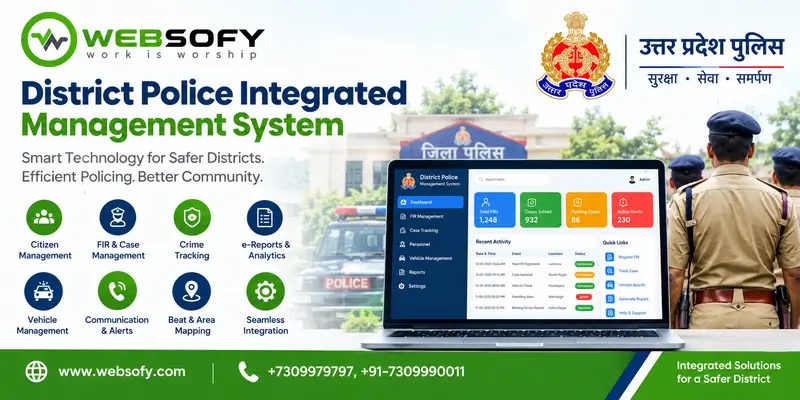
Project overview
A district police integrated management system is web-based software where thanas record daily registers, the SP office sends tasks with deadlines, employees file claims online, and officers monitor everything from one screen. Websofy Software Pvt. Ltd., Lucknow, built this system for Uttar Pradesh Police.
| At a glance | Details |
| Built for | District Police, Uttar Pradesh |
| Built by | Websofy Software Pvt. Ltd., Lucknow |
| Users | SP, ADSP, CO, SHO, SSI, Head Moharrir, branches, employees, accounts, auditor, administrator |
| Languages | Hindi and English labels |
| Access | Chrome, Edge, Firefox and mobile browser |
What is the District Police IMS?
It replaces scattered registers, fax follow-ups and phone calls with one login-based system. Each person signs in with their own account and sees only the work of their own jurisdiction. A thana sees its own records, a CO sees the circle, and the SP sees the whole district.
What problems does it solve?
District offices often cannot tell which thana has not reported, which verification is stuck, or where an employee’s claim is waiting. This system gives every task a deadline and a priority, marks late work in red, and shows the exact desk where each file is pending.
How do thanas record daily work?
Thana staff maintain 13 daily registers, including Cyber Help Desk, Anti Romeo, Mahila Help Desk, Court Moharrir and Pairokar Information. One entry per register per day is accepted, so duplicates are blocked. A thana that misses the day’s entries appears on the daily-entry defaulter list. A routine checklist adds daily, weekly and monthly duties with due times, and officers see who is on time and who is late.
How does the SP office assign work to thanas?
Branches such as verification (DM office), writ, fax, arms, LIU and DCRB enter a record and send it to the concerned thanas with a deadline and priority (Urgent, High or Normal). The thana reports its karyavahi with documents attached. The branch accepts the report or returns it with a remark and a new deadline. Records can be re-sent in further rounds, and a licence verification drive can reach every open licence in one step. Overdue rounds are flagged, and a browser beep alerts officers when urgent work grows.
How do employee TA/DA and medical claims work?
Each employee gets a portal with profile, family, My Health records, TA/DA claims and medical claims. A TA/DA claim moves through Submitted, Office verified, Accounts passed, Officer approved, At treasury and Paid (UTR), and the employee sees the current stage at all times. Medical claims are sanctioned by level: district up to ₹50,000, CMO up to ₹2,00,000, Range up to ₹5,00,000, and PHQ or Government above that. Administrators can change these slabs in Settings.
Claims follow a first-come, first-served queue. A desk cannot act on a newer claim while an older one is waiting, though the SP can hold a claim or allow one out of turn, with a recorded reason.
How is the service record maintained?
The Ganana office writes entries such as annual entry, good entry, reward, commendation, adverse entry and censure, then sends them to the signing officer. The officer receives an OTP on their mobile and signs digitally. Signed entries are locked, carry a digital seal and appear in the employee’s portal. Adverse entries are also communicated by SMS.
What reports do officers get?
- Numeric, graphical and list reports for every register, by date range and thana, with CSV download
- Daily-entry defaulters in a thana-by-register grid
- Overdue karyavahi by thana
- Thana ranking out of 100: 50% on-time karyavahi, 40% daily entries and 10% no overdue backlog
- Routine checklist compliance
- Global search by name, PNO, mobile, licence, writ or case number
How does it keep data secure?
Every action is recorded in an audit trail with name, date and time. Five wrong passwords lock an account for 15 minutes, and OTP login can be enabled. Roles and permissions are set by the district, so each role sees only the modules it needs. Employee salary, GPF and health records are visible only to the employee and authorised offices.
Benefits of District Police IMS
- Centralized administration: Brings multiple police and administrative workflows into one application.
- Improved task visibility: Displays pending, urgent and overdue work for authorized users.
- Structured claim processing: Tracks verification, approval, objections and payment stages.
- Better reporting: Helps officers review register entries, compliance, delays and departmental workload.
- Employee self-service: Provides access to personal records, claims and permitted employment information.
- Public convenience: Enables online status tracking and submission of queries.
- Configurable permissions: Supports role-specific access and jurisdiction-based workflows.
Who uses it?
Thana staff
- Record daily entries and report karyavahi on work sent by the SP office.
- Manage institutions and inspections, and tick routine duties.
SP office, branches and officers
- Send tasks to thanas and review their reports.
- Approve claims and track thana performance.
Employees
- File TA/DA and medical claims and follow each stage.
- View pay slips and GPF, and follow their pension or other files.
Public
- Track verification status and send queries online, with a ticket number and reply on the same page.
How did Websofy build it?
Websofy mapped the registers, tasks and approval paths used in the district, then built them into one system with configurable roles, lists, deadlines and sanction slabs. Bulk import through CSV templates (employees, licences, salary and GPF) reduces data entry, and a wrong row stops the whole import with the row number shown.
What changed
Officers get a live picture of every thana, employees know where their claims stand, and every task has an owner and a deadline. See also our Police Gadna Management Software, the Lucknow Police Citizen Services Portal and the Police Store & Malkhana Management System.
How we approach engagements like this
- Requirement discovery mapped to the real workflow, users and data involved
- Solution architecture and module planning before any code is written
- Secure, tested engineering with clear documentation
- Structured handover, training and post-launch support