
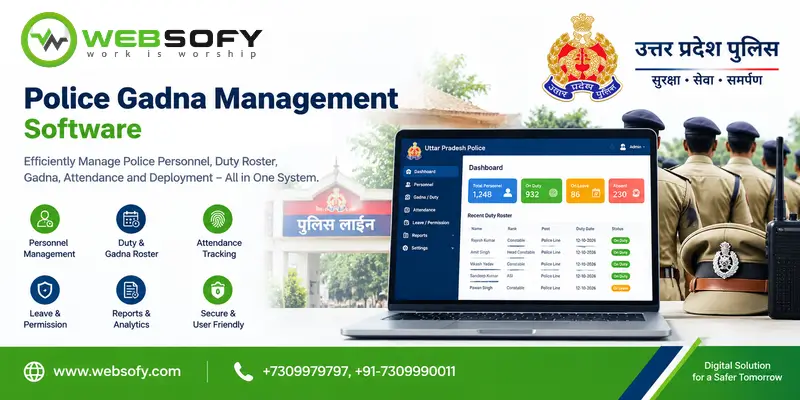
Project overview
Police Gadna management software is web-based police line software that keeps a live count of every personnel, assigns guard, VIP, court production, office and emergency duties by rule, issues arms from the armoury and prepares reports and salary in one system. Websofy Software Pvt. Ltd., Lucknow, built GADNA (गणना), and it is in use at a police line in Uttar Pradesh.
GADNA replaces the handwritten gadna register of a police line with one secure web application. It records every personnel, every duty and every movement of arms, and it keeps the daily count balanced at all times. The system is live at a police line in Uttar Pradesh, where officers use it to run duty rosters, emergency orders and daily reporting.
| At a glance | Details |
| In use at | A police line in Uttar Pradesh |
| Built by | Websofy Software Pvt. Ltd., Lucknow |
| Duty branches | 6: guard, gunner/VIP, court production, inter-district, office, miscellaneous/emergency |
| Modules | 12, from live dashboard to report center and SMS |
| Roles | 12, from CP to GD Munshi, operator and malkhana |
| Database | 71 tables holding a permanent record of every order, arrival, departure and change |
| Languages | Hindi and English, switchable across the whole system |
| Technology | PHP 8, MySQL/MariaDB, runs in any modern browser |
| SMS | Works with any DLT-registered SMS provider |
What is Police Gadna management software?
Gadna is the daily head count of a police line. The handwritten register records how many personnel are present, on duty, on leave, suspended, absent or in training. GADNA keeps the same record digitally, and the figures always balance with the total force.
Total force = available + on duty + leave + suspended + absent + training or attached.
The officer sees this balance live on the dashboard, with alerts, instead of waiting for the evening count.
What problems does it solve?
A paper register is hard to match at the end of the day. Duty rotation depends on memory, a replacement is made without a written reason, and reports for senior officers take hours to compile. After an incident, nobody can say quickly who was on which duty.
GADNA builds rosters by rule, checks rest periods on its own and records every change with its reason and the name of the officer. The personnel gets an SMS when a duty starts, changes or ends, and officers get live figures and one-click reports.
Which duties does it manage?
GADNA covers six duty branches. Each follows its own rules inside one system.
- Guard duty: point-wise standards for each guard point and a fair roster that rotates personnel automatically.
- Gunner and VIP duty: approvals, changes and gunner charges. The system never changes these on its own; only an officer’s order does.
- Court production duty (peshī bandi): outside command, inter-district escorts and rest rules after duty.
- Inter-district duty: personnel sent to other districts, tracked until they return.
- Office duty: personnel attached to branches, placed only with approval.
- Miscellaneous and emergency duty: festivals, fairs, riots and QRT, with an emergency order when the reserve is short.
How does a duty cycle work?
- Report: the personnel reports to the line and joins the reserve.
- Assign: the system checks rank, skill, rest rules and the rule of one personnel, one duty.
- Arms: arms, cartridges and magazines are issued from the armoury on the command order.
- Depart: status changes to on duty and the personnel gets an SMS.
- Rotate: PNO change, force breaking, guard roster or emergency call.
- Return: arms are deposited, the personnel reports back, rests as per rule and rejoins the reserve.
Guard rosters, court production and miscellaneous duties end automatically. VIP, gunner and office duties change only on an officer’s order.
What happens when an emergency needs more personnel?
Example: a riot control order needs 40 constables and the reserve has only 10. GADNA does not stop the order. It draws force in a fixed order:
- The reserve first.
- Then personnel on rest.
- Then guard points, starting from the point with the most personnel.
- Then office and the rest.
Some duties are never broken: gunner (VIP) duty, court production that has already left, and the last personnel at any guard point. A vacated guard point is refilled from the reserve with the same rank, or shown as vacant in an alert. When the emergency ends, every personnel returns to the old point automatically, with an SMS, and the emergency call is recorded in the report.
How are PNO changes and rest rules handled?
ACP, ADCP and DCP line officers can replace a personnel on any duty with another PNO, or swap two personnel. A reason is mandatory: illness, leave, absence, discipline, urgent work, senior order or complaint. Every change goes into the log and the report center, and the personnel are informed by SMS.
Rest (break) rules are set zone-wise by the department, along with the weekly rest day. A personnel does not appear in any duty list until the rest period ends. If needed, an officer can end a rest early from the arrival and departure page, with a written reason.
How force breaking works
When the force is short while a duty is being assigned, the officer chooses rank-wise how many personnel to take, from where and for how long. The choice and the reason are recorded.
Armoury, report and salary
- Armoury (malkhana): arms issue on command order, arrival on return, and overdue alerts.
- Report and action register: a report is raised on a late or absent personnel, and the action taken is kept in a register. GD Munshi is a separate role for this work.
- Salary: monthly bill, pay slip and bank list.
- Report center: every report shows a written summary, the numbers and a graph together, and in Hindi mode the report is only in Hindi. Reports download to Excel and print.
- Import and export: personnel lists come in from Excel; reports go out as Excel, CSV or print.
Where is GADNA in use?
GADNA is in use at a police line in Uttar Pradesh. It runs the daily gadna, duty rosters, emergency orders and armoury issue of the police line, and officers use its reports for their daily review.
How does GADNA keep data secure?
- Login: mobile number, password and captcha. Five wrong attempts lock the login for 15 minutes.
- Passwords: stored as bcrypt hashes, never as plain text.
- One user, one login at a time: a second login with the same account is not allowed.
- Session: automatic logout after 60 minutes of inactivity.
- Permissions: view, add, edit and delete are set separately for every menu, for every role.
- Web protection: secure cookies, content security policy and frame-protection headers. Database, raw, upload and backup files are blocked from the web.
- Audit trail: every login, approval and change is stored permanently with the user, date and reason.
- Data location: the system can run on the department’s own server inside the police line, so the data stays with the department.
- Without internet: on the department’s server, gadna and duty work continues over the police line network even if the internet is down.
Who uses GADNA, and what can each role do?
There are 12 roles, from the Commissioner of Police down to the GD Munshi, the operator and the malkhana. Officers see live figures, alerts and reports for their level. ACP, ADCP and DCP line officers can change duties by PNO. The GD Munshi records reports on late or absent personnel. The operator enters data. The malkhana handles arms issue and return. Each role sees only the menus it is allowed to use.
How did Websofy build it?
Websofy built GADNA with the real workflow of a police line: six duty branches, the rest rules, the emergency order and the rule of one personnel, one duty. The software was installed with HTTPS and scheduled jobs that run every 5 to 15 minutes to close duties and rest periods on time. Personnel, guard point, arms, VIP and court production masters were imported from Excel, roles were assigned to officers by name and mobile number, and the DLT SMS link was set up. Staff were trained, and the register and the software were run side by side before the full switch.
Why trust Websofy for police software?
Websofy Software Pvt. Ltd. is a software company based in Lucknow, Uttar Pradesh, with government and police systems in daily use:
- Police Store & Malkhana Management System, in use at the UP Police Radio Headquarters and as the E-GP Store system for Lucknow Police.
- Lucknow Police Citizen Services Portal.
- E-Rickshaw Verification & Route Management System, built for police use in Uttar Pradesh.
- Case management system for UP Police EOW.
- Election Duty Management Software.
The company works in Hindi and English, trains the staff on site and provides a user manual and an integration manual.
What changed?
In the police line where it runs, officers now see the live force position on one dashboard instead of waiting for a register count. Rosters follow rules instead of memory, the rest period is checked automatically, and every change carries a reason and a name. Personnel get an SMS when a duty starts, changes or ends. Reports are one click away, in Hindi or English, with a written summary, numbers and a graph together.
See also our election duty management software, the Lucknow Police Citizen Services Portal and the Police Store & Malkhana Management System.
How we approach engagements like this
- Requirement discovery mapped to the real workflow, users and data involved
- Solution architecture and module planning before any code is written
- Secure, tested engineering with clear documentation
- Structured handover, training and post-launch support