
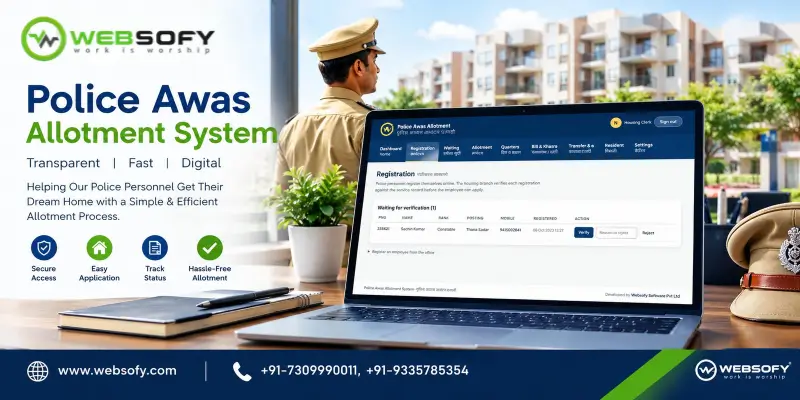
Project overview
Online registration, rank-wise waiting lists, monthly allotment cycles, vacate tracking, and bijli-kuda fee billing for police housing in Uttar Pradesh.
A police Awas allotment system is web-based housing software that registers police personnel, ranks them on waiting lists by application time, allots government quarters, tracks vacation after transfer or retirement, and bills electricity and garbage fees. Websofy Software Pvt. Ltd., Lucknow, built this one for a police housing branch in Uttar Pradesh.
| At a glance | Details |
| Built for | Police housing branch (Awas Shakha), Uttar Pradesh |
| Built by | Websofy Software Pvt. Ltd., Lucknow |
| Technology | Laravel 11, React 18, MySQL |
| Users | Employees, clerk, Reserve Inspector, approving officer, administrator, auditor |
| Languages | Hindi and English |
| Deployment | Office computer or state data centre |
What is the Police Awas Allotment System?
It is a web application that replaces the paper housing register with one online record. It covers registration, waiting lists, allotment orders, possession, vacation, electricity and garbage fees, and reports. Personnel use it from a computer or mobile browser.
What problems does it solve?
Registers kept in legacy Hindi fonts cannot be searched or shared. Without time-stamped applications, seniority cannot be proved. Quarters stay occupied after transfer, retirement, or death, and dues are tracked as a single “paid till” date. The system gives every applicant a visible position, every vacate case a due date, and every bill a status.
How does the waiting list work?
Each quarter type, from Type I to Type V, has its own list matched to rank. For example, a constable is entitled to Type I and an inspector to Type III. Lists are ranked in three steps:
- Approved priority cases, with an order reference.
- System-stamped time of receipt, so whoever applied first comes first.
- Order of entry, for paper applications received at the same time.
Every published list carries a version code, and names are masked for privacy.
How does the monthly allotment cycle work?
| Step | What happens |
| Open | The approving officer publishes all inspected vacant quarters. |
| Choose | Applicants select up to three quarters in order of preference. |
| Allot | The system allots in list order, giving each person the first free choice, and issues orders. |
| Accept | By default, 15 days to accept and 30 days to take possession. |
| Bar | Refusal or non-occupation bars the applicant for a set period (365 days by default). |
A single vacancy can also be allotted between cycles. The system proposes the top eligible applicant, and the approving officer approves.
What happens after transfer, retirement, or death?
The housing clerk records the event, and the system opens a vacate case with a vacate-by date based on the case type. The approving officer can grant special permission with a reason and order number. The Reserve Inspector then records vacation, checks dues, and inspects the quarter before it is released for allotment. The DDO is informed to restart HRA.
How are bijli and kuda fees managed?
The Reserve Inspector enters monthly meter readings, and the system generates electricity and garbage bills at configurable rates. The clerk receives payment and issues numbered receipts. Officers see paid, unpaid, and outstanding amounts by premises and person, print defaulter lists, and waive bills with a recorded reason.
How does it keep allotment fair and secure?
Allotments outside the list need sanction from the CP, JCP, DCP, or SP, with a reason and order reference. They are capped (10 percent by default) and shown in a public out-of-turn register. Every action enters a hash-chained audit log, so any altered entry is detected. Passwords use bcrypt, five wrong attempts lock a login for 15 minutes, and each role sees only the screens it needs.
Who uses it and for what?
Police personnel
- Register with a service number and apply for the quarter type matching their rank.
- Check their waiting-list position, choose quarters, and accept or refuse offers.
Housing branch and officers
- Verify registrations, manage the allotment desk, and record special permissions.
- Track vacate cases, bills, receipts, and reports in numeric, graphic, and text form.
How did Websofy build it?
Websofy first mapped the department’s allotment model, retention periods, and fee structure. The rules were built into one allotment engine, with rates and time limits stored in settings instead of code. The old register was converted to Unicode Hindi and imported, then tested before installation and staff training. Daily backups protect the data.
What changed
Applicants can see where they stand, officers can justify every allotment, and fee dues are visible by premises and person. The housing branch now works from one searchable record. See also our Lucknow Police citizen services portal.
Want something similar?
Tell us your requirement, and we will scope a comparable housing or allotment solution for your department.
Build a similar solution →How we approach engagements like this
- Requirement discovery mapped to the real workflow, users and data involved
- Solution architecture and module planning before any code is written
- Secure, tested engineering with clear documentation
- Structured handover, training and post-launch support